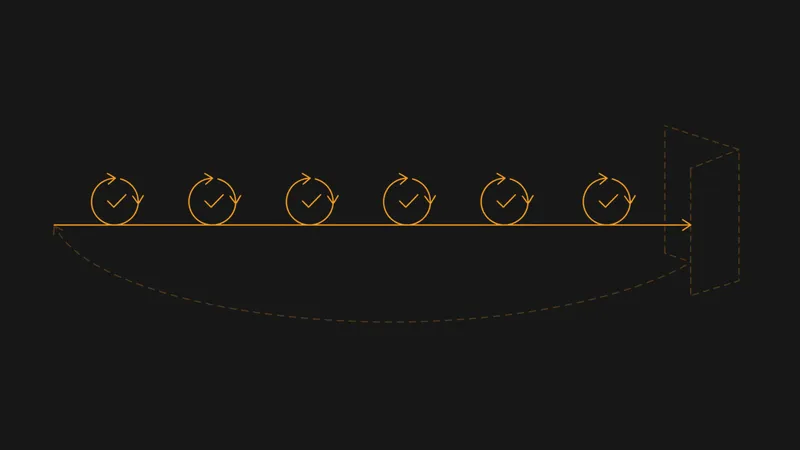
Many Small Loops: Feedback That Hardens Agent Output
Agentic QA holds up through many small feedback loops in the process instead of one big test gate at the end. Three ideas for where a team can start.
Test automation pays off where it delivers fast, reliable feedback. Left to grow without a strategy, it gets expensive. What is worth automating in the first place is covered in the test automation guide. This hub picks up from there and collects material from practice.
The podcast episodes and articles cover automation strategy, test design and maintainability, choosing and switching tools, CI pipelines, legacy and embedded systems, and AI and agents in automation. The tool question rarely comes first: automation holds up once goals, architecture, and the team fit together.
Agentic QA holds up through many small feedback loops in the process instead of one big test gate at the end. Three ideas for where a team can start.
AI in testing writes tests, explores apps and generates test data. It also becomes a test object itself, from chatbots to RAG search.

AI generates movies and apps while teams drown in legacy code. Why we should use AI for the problems that actually hurt, not for demos.

Integrating Agile software testing ensures quality from the start. Transform your testing mindset with DevOps and automated processes.

AI in software testing helps with test cases, test data and error analysis. Testing AI systems means rethinking quality criteria such as data quality.

No-code testing is still needed. The platform covers the lower test levels, but the higher ones stay, and citizen developers rarely test their own apps.

AI for testers helps with analysis, test cases, bug hunting and test data. Weak testers may lose out, good ones build AI into the way they work.

Data warehouse testing needs more than plausibility checks. Assertions generated automatically from transformation rules make results checking reliable.

Types of systems, from desktop and client-server to web, mobile and data warehouse, decide how you automate tests and which tools fit at all.

Test automation pilot projects work best with the three top-ranked tools. Phase two covers one department, phase three the company-wide rollout.

Automated test design spans five levels, from capture & replay to model-based. Higher levels pay off when frequent changes drive up maintenance.

Automation in testing is now a must-have. It reaches well beyond test execution to static analysis, test data, environments and non-functional tests.

Software testing is changing. Unit tests, TDD and automation free testers to design better tests and question the product from the user's point of view.

A fictional look back from 2030: automation took over routine testing work, so testers focus on creative test ideas and take responsibility in teams.

Time wasters in testing include copying test data by hand and fiddling with Word formatting. Automating, learning tools and delegating free up hours.

Testing tools drop off a shortlist for simple reasons: no hands-on evaluation, unstable runs, poor process fit, pushy sales or clunky usability.

Web service testing with WSDLTest: test data comes from the WSDL schema, pre-conditions shape requests, and post-conditions check responses.

DAST testing with ZAP rides on existing regression tests: the proxy records the traffic, then attacks the app. DORA wants that run before each release.

A kernel has to run on every CPU generation, so hardware-in-the-loop testing puts it on real devices. Developers and CI reserve clean machines.

Mutation coverage measures how many deliberately planted bugs your tests catch. It says more than code coverage, especially when AI agents write tests.

More test automation does not mean better quality. Why flaky AI tests, missing strategy, and the wrong roles quietly hollow out your test suite.

Agentic systems are not just agents working alone. Between 8 and 12 agents can cover testing end to end, but humans still judge what AI cannot.

More AI-generated code means more defects, and only about 30% of AI review comments help. Static analysis, test selection and reviews must scale too.

End-to-end test automation stays maintainable with a dedicated HTML test attribute, a central mapper, a three-layer framework and one naming convention.

LLMs in software testing pay off where language is the raw material: keyword docs, rule-based reviews, defect messages. Reasoning models review better.

COBOL unit testing brings mainframe testing into SonarQube, Cucumber and Jenkins. A Java API turns the assertions into debugger scripts.

AI-assisted testing turns a month of test case and test data work into about a week, and plain-language automation widens who can build tests.

Agentic engineering is less about prompts than about the agent environment: your prompt is about 20 of 20,000 tokens. Cleanup agents keep quality up.

From developer to test automation engineer: Why clean code principles decide which automation lasts for years and which doesn't.

Playwright with Python matches nearly all TypeScript features via PyTest plugins. Visual regression, Electron, and web components stay TypeScript-only.

TACON in Leipzig gathers around 130 practitioners for two days of test automation case studies from user companies, last held in September 2026.

Test automation design patterns such as Page Object, Builder and Facade keep test code readable. DRY and YAGNI stop the framework from bloating.

Pekka Klärck began Robot Framework as his master's thesis in 2004. Over 80 companies now back its foundation, and its generic core fits mixed stacks.

Consumer-driven contract testing with Pact checks what an API sends and what its consumers expect. If a contract breaks, the build fails before release.

Testing legacy apps without element IDs works with visual AI selectors. Deutsche Bahn cut mobile checkout regression from two weeks to three hours.

A test automation strategy starts with the problem, not the tool. Map current and target state on the test pyramid; the gap is your scope of work.

Choosing an end-to-end testing framework starts with needs like Safari support, speed and mobile emulation. Cypress, Playwright, Nightwatch compared.

ASQF membership brings free conference tickets, specialist groups and a say in new certifications. The association has united quality people since 1996.

Switching test automation frameworks mid-product is messy, yet a Cypress to Playwright move works. Pricing forced it, AI translated the tests.

For software testing, AI pays off in test data and document analysis. In grown systems, testers' system and domain knowledge still catch side effects.

Quality as an attitude beats test case checklists. Good testing needs solid methods, automation and trust in the people who vouch for the results.

Teaching test automation in Vilnius starts with scripts, APIs and performance tests. Test plans come later, once students have seen systems break.

Property-based testing generates test cases from a specification and found a 17-step LevelDB bug. It gets costly when every test run is billed.

Playwright vs Cypress vs WebdriverIO on four criteria: why Playwright wins new projects, where WebdriverIO trails, and when a switch isn't worth it.

AI code generation pushed up code churn and duplicates on GitHub by early 2024. Testing, precise questions and fundamentals set developers apart.

At Signal Iduna, insurance specialists automate their own acceptance tests. With simple tools and coaching, a release check now runs in three minutes.

A reference implementation as test oracle computes target values for 2,500 signals automatically. The ISO 26262 review then becomes a code review.

End-to-end across web, desktop, database and 3270 hosts: where Robot Framework earns its place, where web-only tools stop, and why it won't die soon.

Many podcasts die after three to seven episodes, because the production effort is set too high. Conferences are the best source of guests for new shows.

Migrating from Cypress to Playwright took a team over a year alongside daily QA. The main hurdles: session handling, request interception, legacy tests.

Which headline do you not want in tomorrow's paper? Risk-based testing starts with that question. One team cut its end-to-end tests by 50 to 60 percent.

CI/CD pipelines for embedded C at Marquardt run on CMake, Google Test and generated mocks. Every bug fix starts with a test that reproduces the bug.

Every mutant reruns your test suite, and that gets slow fast. How incremental analysis in PIT and a focus on core logic make mutation testing pay off.

RATIONAL's test infrastructure runs around 2,000 system tests every night on real combi steamers, driven by a Python framework and relay modules.

Model-based test case design often breaks down between model and concrete test. Two phases fix that: high-level tests first, data and scripts later.

Generative AI in testing speeds up automation with boilerplate code, test case reviews and edge cases. Unit tests generated from code cement its bugs.

Quality in software development moved from a late test phase to a team task. Now AI forces the question many teams never answered: what is quality?

Automated security testing with OWASP ZAP and Nuclei in CI/CD catches standard flaws early and shrinks a 60-page pentest report to four or five pages.

Embedded testing starts before the hardware arrives. Why simulators fail at timing and bus protocols, and when real target hardware belongs in CI.

Form testing for over 255 tax form variants across 16 states: an SMT solver derives valid test data from the model and exposes contradictory rules.

Hybrid app testing at ZDF: 70 to 80% automation, and 90% of failed tests are real bugs. Manual and exploratory testing still catch what scripts miss.

Software testing trends like AI, test data and accessibility: what testers should watch, and why a new tool rarely fixes the real problem.

Swapping a grown XML test monolith for Robot Framework took a year, a custom .NET remote library server and one developer freed from release duty.

Choosing an E2E testing framework starts with your own requirements, such as Safari support or speed. Why Playwright led a comparison of five tools.

AI speeds up routine work, but exploration needs human context it lacks. Quality stays hard to sell, so testers should pair with developers and network.

Five tools, manual transfer errors and no cross-system solution: that was test data management. A store concept changed the entire setup.

The DevOps CALMS model (culture, automation, lean, measurement, sharing) turns a battle cry against burnout and waste into daily team practice.

Mobile app testing, second attempt: HUK Coburg scrapped four years of automation. Now manual testers write keyword-driven tests with Robot Framework.

Sustainability in testing is already hidden among ISO 25010 quality criteria. Dropping redundant test runs saves computing power, and with it money.

Classic test techniques such as decision tables still apply in agile projects. So why does quality suffer when twelve teams work side by side?

Test selection with Teamscale runs only tests that cover changed code, so 6,000 PyTest cases fit a five-minute budget in a ten-minute CI run.

Automated tests catch only about 57 percent of digital accessibility issues. The rest needs manual testing and an early start in the style guide.

BDD scenarios look simple, but Gherkin without real team conversations costs more than it brings. Why five to seven steps keep a scenario readable.

The House of Agile Quality rests on a test foundation and three pillars: roles, approach and tools, topped by lean quality engineering methods.
Cypress component testing runs in a real browser, so tests are more stable than with Jest's emulation. How it rights the test pyramid, and its limits.

6.5 hours of test runtime, reduced to 10-15 minutes: How test case selection across C++ and Java makes it possible.

Contract-based testing lets provider and consumer agree on a versioned contract. Breaking changes then surface in the CI pipeline before integration.

In Selenium automation testing, Selenium only drives the browser. Good selectors, page objects and the vendor drivers in Selenium 4 keep tests stable.

AI test automation turns 200 failed tests into seven real causes. Machine learning groups failures by root cause and frees testers to write new tests.

BDD testing uses Given-When-Then scenarios so business stakeholders and developers share one understanding of a feature before any code is written.