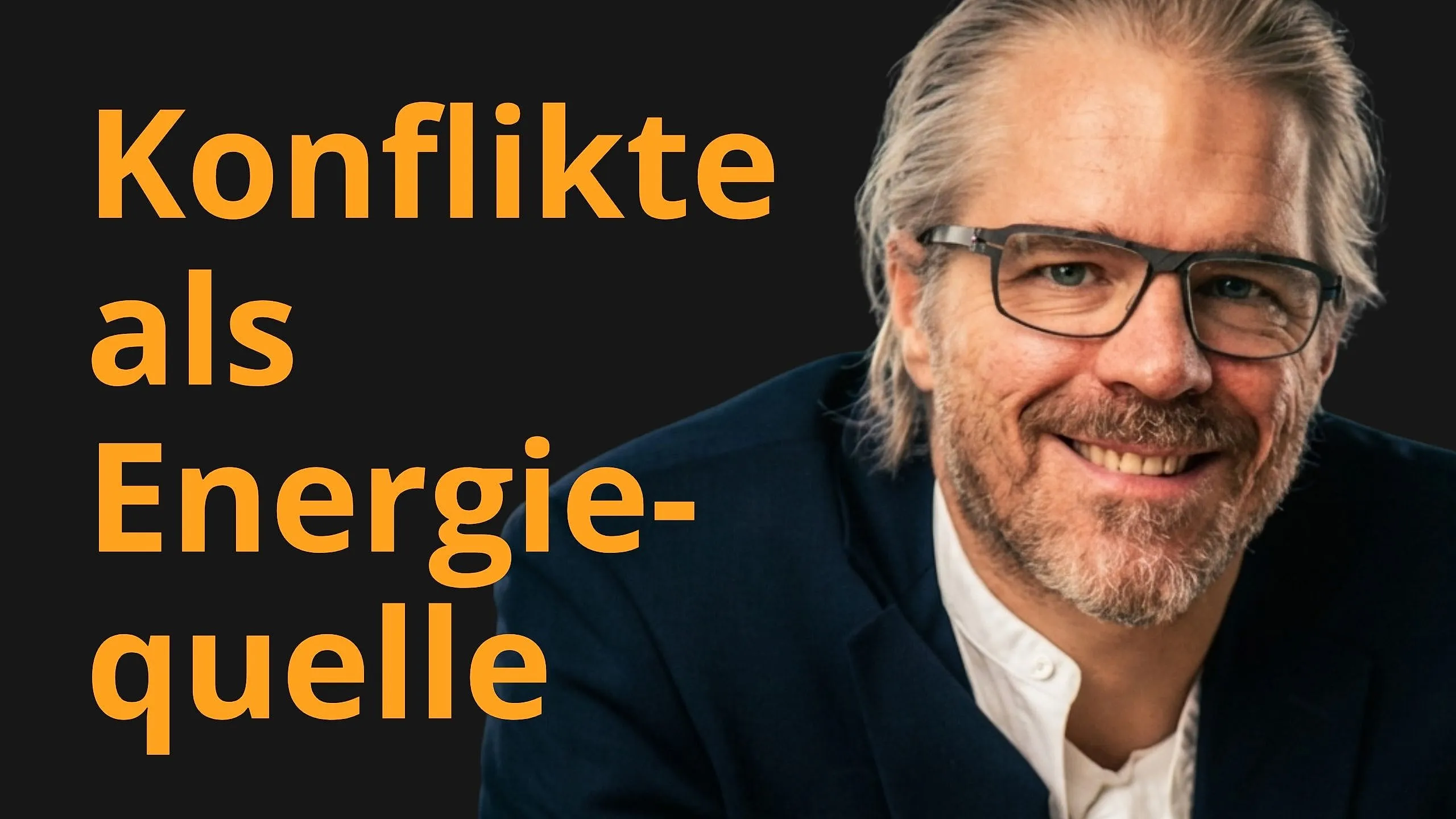
A team conflict is not a disruption but a starting point for development. Every visible dispute sits on top of a deeper issue, whether that’s a fight over who does what, a role conflict or a question of power. As long as escalation stays low, managers can put the tied-up energy to work by staying impartial, using “I” messages and making the shared goal visible again.
Key Takeaways
- Conflicts only turn destructive when emotions create lasting resentment: a plain difference of opinion without emotional hardening isn’t a conflict yet.
- The iceberg model applies to team conflicts: the trigger is visible, such as a role dispute or an unfair share of work, while underneath there is usually a relationship or identity conflict.
- Up to the third escalation stage in Friedrich Glasl’s model, managers can still resolve conflicts internally; from stage four onward, outside facilitation is needed.
- “I” messages instead of “you” accusations are the most effective way to talk, because they put nobody in the dock and keep the facts within reach.
- Team members who want to resolve a conflict should first talk one-on-one with the person involved before bringing in allies.



Conflict in Teams Is Normal, the Trouble Starts Later
Disagreement is the normal state of affairs in a team, not an alarm bell. Two people hold two opinions that don’t match: that alone isn’t a team conflict. A conflict only develops once the disagreement lasts, resentment hardens and emotions push the facts aside.
Right at this threshold, it gets hard for the people involved to bring things back to a factual level. A familiar picture from testing: the tester comes back with a bug for the third or fourth time. What starts as factual feedback becomes emotionally loaded, and it takes tact to keep working constructively with the developers.
Ruben Gotthardt, a coach and process facilitator who specializes in team conflicts, turns the usual view upside down. Behind every visible conflict lies a chance to develop. Without conflict there is no next step in development, not in the animal kingdom, not in the plant kingdom and not among people. Friction is the vehicle of change, not its enemy.
What You See on the Surface Is Rarely the Real Conflict
Conflicts work like an iceberg: above the waterline you see the dispute, below it lies the real issue. To resolve a conflict, you have to separate the two levels. What is it visibly about, and what is it really about?
A conflict over who does what often shows up in something trivial. Who takes on the unpopular dishwashing during a shift becomes a bone of contention: on the surface a trifle, underneath a relationship conflict between people who don’t get along. The role conflict becomes visible, the relationship conflict stays hidden.
In a positional fight, a deeper question sits beneath the visible power struggle. Two people battle by every means for a leadership position. What you see is the fight for the job. Underneath, it’s about identity, about a claim to leadership that touches the person’s sense of self. You first have to become aware of this deeper level to understand what is really at stake for you.
Unresolved conflicts don’t go away; they move with people. When someone changes roles, the old friction comes along. That’s how trench warfare breaks out between departments that seem to have nothing to do with each other, until it turns out that they once worked together on a project and something happened back then. Over time, this spins a web of conflict that blocks a great deal in the company.
Escalation Stages Decide Who Can Still Resolve a Team Conflict
Conflicts escalate in stages, and the stage determines which solution can still work. Conflict researcher Friedrich Glasl broke this model down into nine stages in total. In practice, a look at the first transitions is enough.
It starts with hardening as the first stage. Debate and polemics follow. Glasl calls the third stage “actions instead of words”: the parties stop talking to each other and go looking for allies and coalitions.
Up to this point, the conflict can be resolved internally. A manager, head of department or project manager can still facilitate it, provided they handle it with confidence. From the fourth stage on, that’s no longer enough. Black-and-white thinking takes hold: each side makes itself look better by making the other side look worse.
At this stage, outside support is needed, meaning facilitation or mediation, to create a situation that can end in a compromise. A win-win solution is off the table by then. At the end of every full escalation is an attempt to destroy the opposing system, not necessarily physically, but materially or psychologically. In a company, the power intervention then means splitting up parts of the team, because otherwise the project itself is at risk.
As long as escalation stays low, the energy tied up in the conflict can be used to win people over to the cause and turn opponents into friends.
Are You Still Part of the Conflict, or Has It Got Hold of You?
The first question for anyone who wants to steer a conflict: am I still part of the disagreement, or am I trapped in it? If you can still analyze the conflict, you’re on the outside. If you’re tangled up in coalitions and emotions, you’ve lost the distance you need.
That distance takes self-reflection. You need an observer’s role, the ability to step into a meta-perspective and see yourself in the situation. That includes clarity about your own role and your own personality.
This clarity creates what you might call an attitude filter. The path runs from your role through your personality to your own attitude, and this filter makes you more effective when things get tense. You notice earlier when something is getting out of hand, and you can step in before the hardening goes public.
Sometimes it doesn’t take many words. If a conflict is smoldering behind closed doors, it’s enough to open the door, walk into the room and ask: what’s actually going on here? Anything that stays hidden can climb the escalation ladder until it’s out of your reach.
How Managers Turn Tied-Up Energy into Momentum
A manager can put conflict energy to use by staying impartial and not putting anyone in the dock. That’s the central rule. Even someone who lets their combativeness run wild and knows how to get their way must be allowed to be who they are without being cast as the guilty party. Otherwise the tied-up energy grows stronger instead of dissolving.
Authenticity works better than any facilitation technique. A manager who says “I got this wrong” or “I contributed to this problem” opens up the space. That takes the courage to let your own vulnerability show.
Concrete tools that release pressure without creating new coalitions help. A “wailing wall” in the office, where everyone can write down on a slip of paper what bothers them, makes resentment visible. Asking afterward whether everyone is willing to tear up their slips brings people back to a sense of connection. Most people want to move forward on a positive note.
An “I” message keeps the question of blame out of the room. The sentence “You’re a great team, I can’t bear to watch you fight like this” avoids the accusing “you.” In the conflict itself, the parties are already throwing that accusing “you” at each other, which is why whoever facilitates has to avoid it consistently.
A shared vision has the biggest impact. An attractive picture of the future that people want to work toward turns conflict energy into forward energy for the whole team.
What You Can Do as a Team Member Without a Leadership Role
If you don’t have a leadership mandate, start with a direct conversation. One-on-one, with the person involved, no detours. Any other route already amounts to a coalition: as soon as someone notices a group forming, the speculation starts.
In the conversation, speak from your own perspective and talk factually about one specific situation. Describe what you observed and say what it does to you: “That hurt me,” “that’s why I’m angry,” “I couldn’t sleep for two days.” Then ask how the other person feels about it and suggest an agreement for similar situations in the future.
Only if the direct conversation fails does the next step go through the responsible authority, such as the test manager or project manager. There, too, you speak from your own perspective rather than accuse. The manager’s job is then to hear both sides and bring them together in one room.
Before the direct conversation, many people play a worst-case scenario in their heads: it could get even worse. That scenario rarely comes true if you really show yourself and stay with your own perspective. You just have to go through it.
From Interpretation Back to the Facts
The longer a conflict smolders, the more people interpret instead of listening. Every situation is shaped by what’s happening right now and by the experiences of everyone involved. In a team, entire life stories sit around one table.
Beyond a certain level of escalation, you no longer really listen to the other person. You already know what they’re going to say and build your own interpretation from it. Lines like “someone told us that 30 years ago” or “we’ve always done it this way” are signs of this state.
The way back to the facts leads through the emotions. The central question is: what is this actually about for you, personally? In the early stages, it often turns out that both sides want the same thing and simply took a different turn at one point. That insight frees up the energy to build the ship together and sail in the same direction again.
Frequently Asked Questions
When does a difference of opinion turn into a real conflict?
Only when it becomes prolonged and emotions come into play. Two people with two different opinions is the norm in teams, not a cause for alarm. It becomes a conflict when a disagreement hardens and emotions overshadow the factual aspects. An example from the testing environment: The tester brings up a bug for the third or fourth time, and the factual feedback takes on an emotional tone.
Are conflicts within a team a sign of poor collaboration?
No. Conflicts are the starting point for development, not its enemy. Ruben Gotthardt, a coach specializing in team conflicts, turns the conventional view on its head: Without friction, there is no next step in development. As long as the conflict remains low-level, the energy locked within it can be harnessed to win over others to the cause and turn opponents into friends.
Why do team disputes often flare up over trivial issues?
Because the visible issue is rarely the real one. Conflicts work like an iceberg: Above the waterline is the argument over who will do the unpopular dishwashing during the shift; beneath it lies a relational conflict between people who don’t get along well. In the battle for a leadership position, underlying the power struggle is a question of identity.
When can a manager still mediate a conflict on their own?
Up to the third stage of escalation according to Friedrich Glasl’s nine-stage model. After hardening of positions, debate, and polemics comes the stage of “actions instead of words”: the point at which the parties stop talking and start seeking allies. Up to that point, a department or project manager can mediate internally. From stage four onward, black-and-white thinking sets in, and external facilitation or mediation is needed.
How can I tell if I’m too deeply involved in the conflict to mediate?
The litmus test is your ability to analyze. If you can still describe and contextualize the conflict, you’re still on the outside. If you’re entangled in coalitions and emotions, you’ve lost that distance. This requires an observer’s perspective (that is, the ability to shift to a meta-perspective) as well as clarity about one’s own role and personality.
Why do “I” messages work better than accusations in conflict discussions?
They keep the question of blame out of the discussion. Accusatory “you” statements are already flying back and forth between the parties to the conflict, so the mediator must consistently avoid them. A statement like “You’re a great team; I can’t stand seeing you fight like this” doesn’t put anyone on the defensive and keeps the discussion grounded in facts.
Should I first look for allies within the team when a conflict arises?
No. The first step is a direct, one-on-one conversation with the person involved. Any other approach is already a form of coalition-building, and as soon as someone notices that a group is forming, speculation begins. Only if the direct conversation fails should you go through the appropriate authority, such as the test or project management.
What helps when a dispute devolves into nothing but interpretation and no one is listening anymore?
Ask about their personal concerns: What is this really about for you, on a personal level? The longer a conflict simmers, the more you can predict what the other person is going to say. Phrases like “we’ve always done it this way” are telltale signs. In the early stages, it often becomes clear that both sides share the same goal but have simply taken different paths to get there.