Learning and unlearning in the AI era means developing the human capacities that AI cannot replace while deliberately letting go of work patterns that no longer serve people or organizations. Critical thinking, ethical judgment, collaboration, and knowing how to learn are the skills that matter. Velocity and top-down decision-making are among the patterns worth questioning.
Key Takeaways
- Students who used ChatGPT to complete tasks showed a 47% reduction in cognitive capacity and failed to retain the material afterward, according to research cited from NMAIT.
- 95% of companies investing in AI report no measurable return, because AI adoption is driven by hype rather than connected, governance-level strategy across all layers of the organization.
- Offloading tasks entirely to AI rather than treating it as a collaborative partner transfers responsibility away from the human and blocks genuine skill development.
- The disappearance of junior software engineering roles due to AI creates a pipeline problem: without junior engineers gaining experience, there is no path to producing senior engineers.
- Ethical behavior, critical thinking, and the ability to learn how to learn will outlast any specific tool, language, or framework as the durable competencies for professionals.



AI can write the code, so the question shifts to what humans still own
The capability question is settled. AI writes code, drafts strategy, generates tests, and handles most discrete tasks. Graziela Tonin frames the real question differently: how do institutions, businesses, and individuals transform when the machine handles the task, and what stays uniquely human in this new era.
That era goes by names like the compute supercycle or the AI supercycle. The shift is not about taking a course to understand large language models. It is about who leads the new world and on what terms. Humans still guide the AI, at least for now. That guidance is a decision, and it can be made well or badly.
Why students who lean on AI lose cognitive capacity
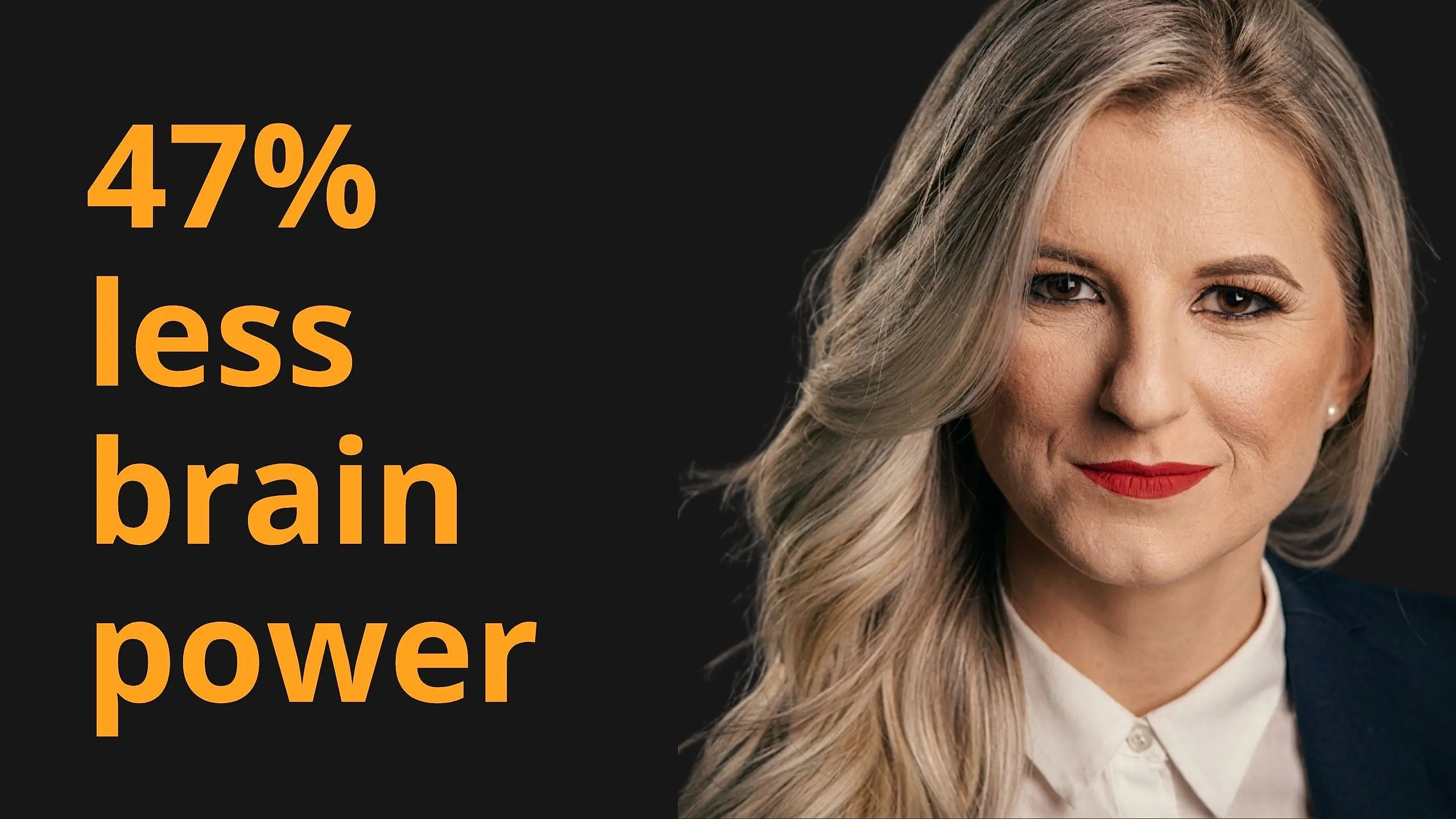
Outsourcing thinking to AI measurably weakens the ability to think. Graziela points to a study from MIT that split students into two groups, one using ChatGPT and one not. The group that used ChatGPT showed a 47 percent reduction in cognitive capacity. After a few days, those students could not recall the context. They had not actually learned.
The danger is not just failing to build a new competence. It is losing cognitive abilities you already had. When a person hands the whole task to AI and asks for the finished output, the work gets delivered but the learning does not happen.
Anthropic’s own research on how people use Claude points the same direction. In computer science work, many users ask the AI to deliver the task outright. They go straight for the answer rather than collaborating or discussing. They transfer the responsibility. That transfer is the risk.
The fix is to treat AI as a co-author, not an author
Using AI well means working with it through a process, not dropping in a request and collecting the result. The difference is between asking AI to do the task and reasoning alongside it as a partner.
This requires safe environments where people can experiment. Universities and companies both need spaces where you can test, try, and figure out how the tool actually helps you learn and evolve. The goal is AI as a co-author in building software, not the sole author who leaves you behind.
Nobody knows the best way to use AI yet. Models multiply, the hype around generative AI keeps moving, and agentic AI is arriving with the power to make some decisions on more data than a person can hold. Without collaboration and shared experiments, building a better way to work with these tools at the current pace is unlikely.
The university becomes a hub, and the professor becomes a guide
Knowledge is no longer something you travel to a university to collect. Information surrounds us, from countless countries and strong universities, all accessible over the internet. The professor stops being the holder of knowledge.
What the university can still offer is trust and direction. It can be a hub where the shared content is trustworthy. It can design the journey of a professional career, help students make good decisions, and develop critical thinking and ethical judgment. The professor becomes a guide and a sponsor of each student’s own learning.
AI fits this model when it personalizes the path. In software engineering and computer science, AI tutors can sit with students around the clock and meet each learner at their own level, adapting to the specific exercise or problem in front of them. Used this way, AI improves a student’s knowledge instead of replacing it. Universities can help build these tools and teach students to use them so the result is a superpower rather than a reduced intelligence.
Collaboration is the human response to problems that change too fast
Sharing knowledge across a community is how humans keep up when technology changes at unprecedented velocity. On one side sit complex problems: geopolitics, war, environmental pressure. On the other sit strong technologies and knowledge that shift faster than any one person can track.
Graziela draws the lesson from Agile practice, where squads and guilds exist to discuss, collaborate, and build better solutions together. If a quality and test specialist and an AI specialist pool their experiments and their learning, they reach a better way to handle the problem than either would alone.
The pandemic vaccine is her reference case. It came faster because scientists around the world collaborated, each contributing a piece of research that connected into a result that saved many lives. The conclusion she draws is direct: humans need to collaborate more.
We don’t, the environment don’t need us. We need the environment. The environment could survive without you. — Graziela Tonin
What you actually need to unlearn
Unlearning means stepping back to rethink what work you create, for whom, and how. Agile principles already point at sustainable work, empathy, and delivering value over pure competition. Many of those human qualities got lost along the way.
People started acting like robots, facing each day with the same heavy load of tasks. Mental health problems rose inside companies, and that correlates with lower productivity and weaker business results. The cycle of shipping new products and services, automating more, and moving faster crowded out any thought about impact on people, society, and the environment.
The paradox is sharp. A small city in Brazil still has no electricity, while the same ecosystem pours millions into IT infrastructure, cloud, and data centers to feed and improve AI models. Unlearning is the discipline of pausing to ask what kind of work is worth creating before automating more of it.
Why 95 percent of companies see no return on AI
Most AI investment fails because it is driven by hype, not strategy. Graziela cites research showing that 95 percent of companies investing in AI see no return. Only 5 percent can see or measure value.
The reason is structural. These efforts are isolated experiments rather than strategic decisions connected across every layer of the company. Someone tries something on the side to help, but it never links to governance, risk, or the actual business strategy.
AI belongs in the strategy and in the governance, partly because of the risks it carries, including cybersecurity. That only works inside a culture where decisions are made on data, discussion is collaborative, and the environment is safe enough to test and suggest better ways of working.
Top-down leadership no longer fits the speed of the market
A leadership model where the top defines strategy and passes it down cannot keep pace with current problems. Time to market is too tight and the problems are too complex for decisions to flow from a single level.
Leaders need to architect strategy with the people closest to the work. Graziela describes consulting clients who ask her how to solve a problem, when the people who have spent twenty years talking to the customer already hold the signal. Start by listening to them, collect the data, and make a better decision from it.
This also forces a rethink of how performance gets measured. Velocity as a KPI looks worse than ever when AI lets anyone ship a large volume of code that may carry vulnerabilities and security flaws. KPIs have to be redefined to connect with real results and a more collaborative way of working.
The junior engineer problem nobody has solved
Cutting junior roles today removes the pipeline that produces seniors tomorrow. Graziela states the contradiction plainly: if AI displaces the junior software engineer, where does the senior software engineer come from later.
Her answer is to strengthen the connection between companies and universities early, during the undergraduate years. Experienced engineers can share how to use AI well, where the risks sit, and how to approach real, complex problems. Bringing actual problems to students through problem-based and project-based learning prepares them for the real world.
The connection helps the company too. Introduce students to the company’s culture early, and they arrive with more maturity, better prepared to join a team and deliver for customers.
The World Economic Forum number on reskilling
At least 40 percent of the population will need to reskill or upskill for the future of work. That figure, which Graziela attributes to World Economic Forum research, means learning a new skill or transforming an existing one to fit what the market now needs.
Going alone is the slower path. Re-skilling at this scale pushes toward more partnerships, more collaboration with universities, and bridges that close the gap between education and the market.
The skills worth building when tools keep changing
When languages, frameworks, and tools keep shifting, the durable skills are the ones underneath them. Graziela puts learning how to learn first. Faced with a flood of data on any topic, you have to judge which sources to trust and how to use them, and AI can surface ideas but cannot make that judgment for you.
Solving complex problems stays human because every customer is specific. The domain may be familiar, but that customer has its own characteristics, its own way of negotiating requirements and setting a schedule. Teamwork matters for the same reason: you can start a piece of software alone, but scaling to more customers needs others.
For hiring, Graziela values commitment, ethics, and respect for diversity above tool knowledge. Tools and frameworks can be learned together from tutorials and materials. How a person thinks, behaves with a customer, and treats people is harder to teach and weighs more, even commercially.
| Skill | Why it lasts |
|---|---|
| Learning how to learn | Information is abundant; judging and trusting sources is the work |
| Solving complex problems | Every customer is specific and needs a tailored approach |
| Teamwork | Scaling software beyond a prototype requires others |
| Critical thinking and ethics | Tools change; judgment and conduct hold value over time |
Unlearning includes how you connect with yourself
The hardest thing to unlearn may be the way we spend our time. Graziela ties the rise in workplace mental health problems to not saving time for ourselves, time for a park, for piano, for yoga, for whatever restores a person.
Reconnecting with yourself is part of the same shift as rethinking how we do business and define a career. So is the impact on the environment, a concern that slipped back over the last two years under the weight of AI and geopolitics. There is only one environment, and it does not need us. We need it.