The Blue Angel for software (UZ215) is the world’s first ecolabel for software products, awarded by the German Environment Agency and RAL. It assesses resource efficiency, autonomy of use and hardware longevity. Certified software has to run on hardware that is at least five years old, publish its measured values and receive free security updates for at least five years after it is no longer offered.
Key Takeaways
- The Blue Angel for software doesn’t demand perfect efficiency, it demands transparency: vendors measure their energy consumption and publish the figures wherever the software can be obtained.
- Certified software must run on hardware that is at least five years old, and the vendor must provide free security updates for at least another five years.
- In practice, certification takes around three months rather than the one people hope for, because the review at RAL alone can take up to three weeks.
- The Blue Angel already works as a differentiator in public tenders, because it is the only recognized ecolabel for software worldwide.


What the Blue Angel Tells You About Software
The Blue Angel for software is the world’s first ecolabel for software. It is awarded by the German Environment Agency and RAL and belongs to the German government’s environmental label, which many people know from printer paper.
The Blue Angel has existed for software for some time, but originally only for desktop applications. That focus no longer matched the reality of today’s systems. In 2024 the label was revised, and since then it has also covered smaller server applications and mobile apps. Six software products carry the label so far; before the revision, there was just one.
Seeing the label doesn’t automatically tell you that the software is especially efficient. What it actually says is that the vendor has measured the resource consumption and published it. The numbers are out in the open instead of being kept in-house.
Transparency Instead of Top Marks: Why the Measurements Go Public
At its core, the label is about disclosure, not an efficiency ranking. Software is hard to compare because feature sets differ so much. But once the figures are public, there’s an incentive to actually make the product more efficient.
The published values are available wherever you can obtain the software. A summary document has to be published, along with further documents containing all the measured values. So you don’t just see a logo; you can check how resource-efficient a product really is.
Over time, this is meant to lead to a comparable scale, similar to the energy efficiency classes for refrigerators. That effect kicks in once several vendors of comparable software get certified. Then you get a sense of roughly how much this type of software consumes.
What the Label Requires Beyond Energy Consumption
The Blue Angel covers more than resource efficiency. A second block is about autonomy of use. The idea is that operators can keep running the software even if the vendor drops out.
Specifically, the label requires that:
- The software runs on hardware that is at least five years old.
- Free security updates are available for at least five years after the software is no longer offered.
- Interfaces and the data formats used are documented.
The reason is material: building hardware takes a lot of raw materials and causes a lot of emissions. The longer devices stay in use, the better the balance. For you as a customer, it’s a guarantee that you can run the software yourself for a long time, even without the original vendor. That’s the opposite of planned obsolescence and of subscription models that keep you locked in mainly because of the updates.
How Energy Consumption Is Measured
There are two ways to measure consumption. If you run the software live and control your own data center, including all the values, you can measure real operation over a longer period.
The second way is more common: you define the standard usage scenarios for your software and measure those. Even on a dedicated system, that’s a lot of work.
For this case there’s the Green Metrics Tool from Green Coding Solutions in Berlin, which is itself certified and built for the Blue Angel. It maps the software’s life cycle phases, runs the measurements and delivers the figures together with Excel sheets. The provider’s servers are seven to eight years old, so the hardware age criterion is met along the way. The tool also outputs CPU utilization, RAM usage and other values automatically.
One criterion connects consumption and production: the energy used in one year of real operation must be lower than the energy that went into production. The label doesn’t yet have a direct answer to the growing energy appetite of agentic coding, but it is continually being developed.
Certification Takes Longer Than You’d Expect
Plan for more time than a first glance suggests. Around three months of work is realistic, including about three weeks of review at RAL alone, depending on their workload.
It starts with an auditor. Around 20 people are certified as auditors. Nobody is allowed to audit their own software, so you always need an outside person.
The technical core is fully dockerizing the application. The entire run has to be automated: from an empty machine, through setting up the database and search index and importing the data, to the finished scenario and the teardown afterward. The application is then measured at least ten times on the measurement server.
A Blue Angel exporter generates the base documents from the measurements. Seven documents have to be filled in, describing the functionality, interfaces and data formats, among other things. The auditor checks everything, everyone involved signs, and then it goes to RAL. After their review, in the best case, you get the label.
Recertification: Each Version Is Valid for One Year
Certification is valid for one year, after which you have to measure again. Software lives on in new versions, which is why the label always reflects a specific version.
Recertification no longer requires an auditor. You measure again and send the documents directly to RAL, which reviews them once more. There’s a limit on the energy consumption of the scenarios: it must not have risen by more than 10 percent over the previous year, unless there are good reasons. If the standard usage scenarios don’t change at all, the measurement baseline stays stable anyway.
What Certification Costs
The costs split into the auditor’s fee and the RAL fees. You negotiate the fee with the auditor; it often depends on the number of scenarios to be checked plus a base fee. There’s no fixed rate card.
At RAL the structure is clearer. Each application costs around 600 euros, plus an annual fee based on revenue. For new software with less than one million euros in revenue, that comes to about 750 euros a year.
Open-source software gets some relief: if you don’t make any revenue with the product, you can be exempted from the RAL fees.
The Blue Angel Pays Off as Marketing
No company gets certified out of pure altruism, and it doesn’t have to. The practical benefit is a kind of attention that’s hard to buy any other way.
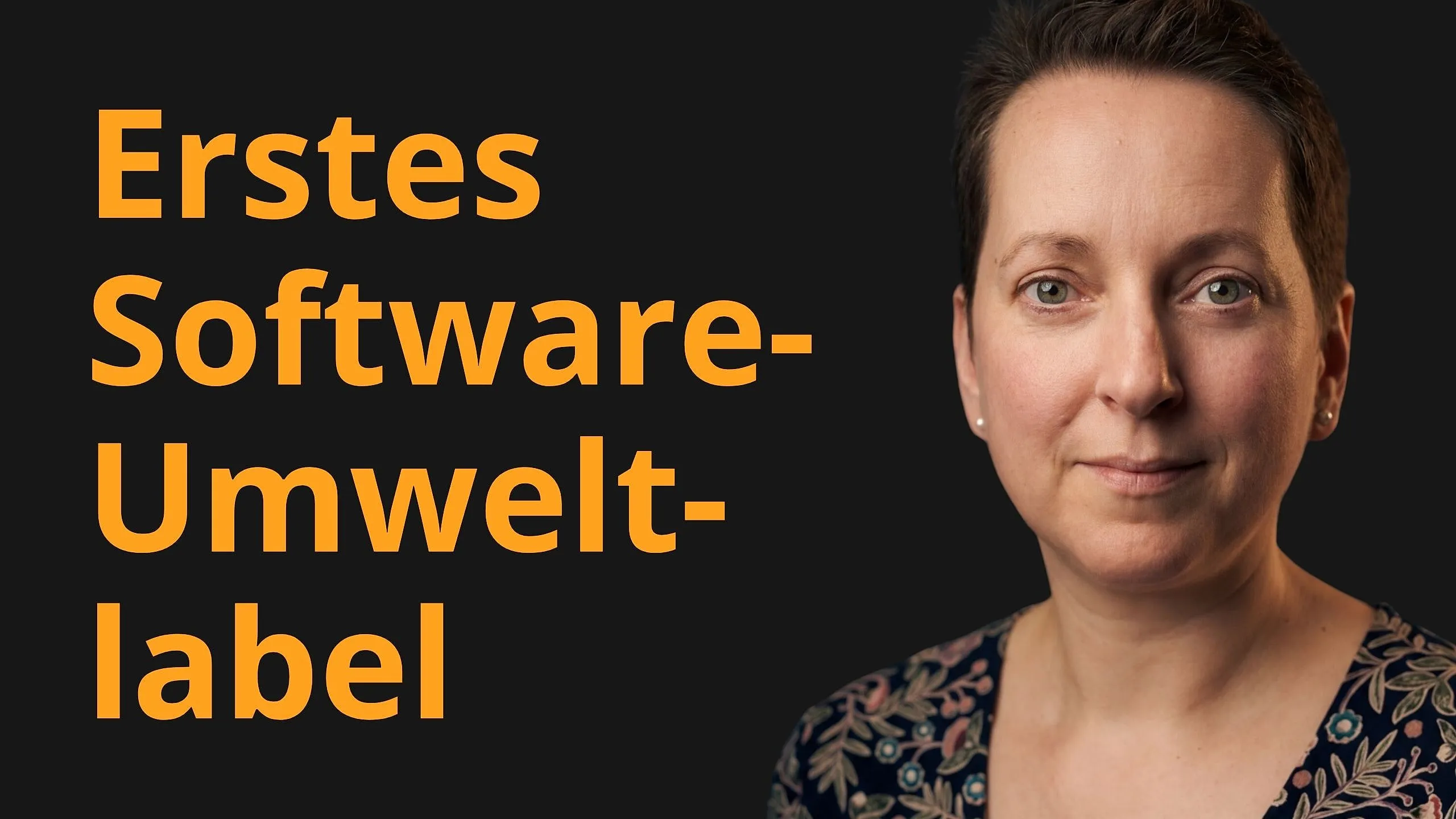
Anita Schüttler had a commercial software product of her company certified, partly to lead by example and to be able to talk about the process. The investment came to a few thousand euros plus working time. For the visibility it generated, especially for a new product, she considers it a good deal.
“Talking is one thing, doing makes a much stronger statement. It’s a way to underline your commitment.”
(Anita Schüttler)
The label opens up different conversations and gets people to take a second look at the product. If you’ve been working on green software for a while, certification backs up your commitment.
Why the Label Carries More Weight in Tenders
In public sector tenders, the topic already appears as a criterion that earns extra points. Usually the tender asks for an ecolabel in general rather than naming the Blue Angel. Since it’s currently the only ecolabel for software, it can give you an edge.
So far, the energy efficiency debate has focused heavily on data centers and hardware. But the real driver of consumption is software. For hardware and data centers to be efficient, the software has to be efficient too.
Where to Start If You Want to Get Certified
Your first stop is the Blue Angel website for software under the designation UZ215. That’s where you’ll find the award criteria, which are fairly extensive.
Rather than working through the document alone, it’s worth reaching out directly. The site lists who works as an auditor. Start a conversation, get advice or sit in on a talk about the topic. That’s much easier than trying to get through the criteria on your own.
Frequently Asked Questions
Does an environmental label on software mean that it is particularly energy-efficient?
No. The label primarily certifies that the manufacturer has measured resource consumption and disclosed the results. A summary document and additional materials containing all measurement values are available where the software can be purchased. This does not involve an efficiency ranking, because products with different feature sets are difficult to compare directly.
For what types of software can the Blue Angel certification actually be awarded?
Since the 2024 revision, the Blue Angel for Software has also applied to smaller server applications and mobile applications. Previously, it covered only desktop applications, which no longer reflected the reality of today’s systems. Six software products bear the label; before the revision, there was only one.
What requirements does the label impose beyond energy consumption?
A second set of requirements concerns operational autonomy. The software must run on hardware that is at least five years old. After the software is no longer offered, free security updates must be provided for at least five years, and interfaces such as data formats must be documented. Operators should be able to continue using the product even if the provider withdraws.
How can an application’s energy consumption be determined for certification?
There are two possible approaches. Those who operate the software in production and monitor all metrics in their own data center measure actual operation over an extended period. More commonly, standard usage scenarios are defined and measured, which remains a time-consuming process even on a dedicated system. One criterion combines both approaches: one year of use must not consume more energy than the manufacturing process.
How much time should be allocated for the certification process?
About three months of work is realistic, including roughly three weeks of review by RAL, depending on their workload. The process begins with an external auditor, as no one is allowed to audit their own software. About 20 people are certified to perform this work. The application is tested at least ten times on the measurement server, after which the auditor reviews the documentation.
Does certified software need to be re-certified regularly?
Yes, annually. The certification reflects a specific software version and is valid for one year. During recertification, an auditor is no longer required: You run new measurements and send the documentation directly to RAL. The energy consumption of the scenarios may increase by no more than 10 percent compared to the previous year, unless there are valid reasons for a higher increase.
What fees can a manufacturer expect to pay to RAL?
Each application costs around 600 euros, plus a revenue-based annual fee. For new software with revenue under one million euros, the fee is approximately 750 euros. Those who do not generate revenue from the product, such as with open-source software, may be exempt from RAL fees. The audit fee is negotiated separately with the auditor.
Does an eco-label for software offer advantages in public tenders?
Yes. In public sector tenders, this topic already appears as a criterion through which extra points can be earned. The terms used there generally refer to an “eco-label” in general, not the Blue Angel by name. Since it is the only eco-label for software, this can be used as a distinguishing feature.