
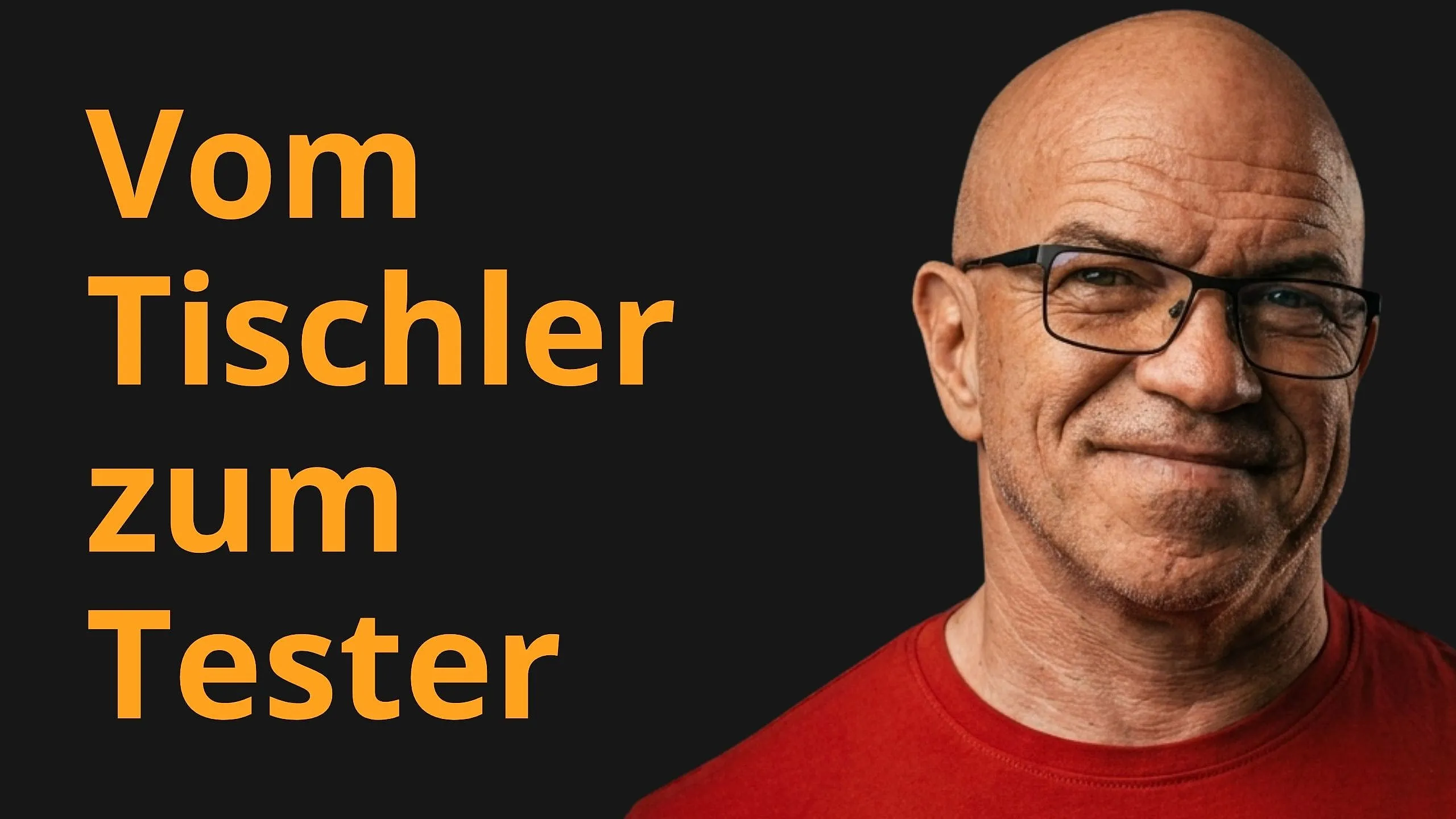
Moving from a skilled trade into software testing works when you build on strengths you already have, such as accuracy and a sense for quality, and learn new skills alongside your job. The ISTQB Foundation Level provides the technical groundwork. AI tools like ChatGPT take over routine tasks rather than the tester’s job, and the AI test engineer is the one who actively learns to use them.
Key Takeaways
- People who ignore AI will be replaced, people who use it will not: Rudolf Groetz works with ChatGPT every day but insists that its output always has to be checked critically and adapted.
- The ISTQB Foundation Level provides the toolkit for agile testing: concepts such as equivalence partitions and decision tables help with test design in Scrum teams as well.
- AI will take over standardized routine work such as manually checking Excel lists, while complex quality judgments about requirements coverage remain a human task.
- Six years ago Rudolf Groetz founded the Testbusters community in Vienna, which now has around 1,500 members and connects testers from around the world in remote meetups.
- The New Voices format gives people without stage experience a safe place for their first talk, because high demands on titles and abstracts keep newcomers out of traditional conferences.



The AI Test Engineer: Routine Goes, Judgment Stays
Will AI replace software testers? Rudolf Groetz, a former carpenter who has worked in IT for decades, has a clear answer: artificial intelligence will change the job, but it will not do away with the tester. For him, the role of the AI test engineer is defined by a simple line. AI replaces work that follows a standard pattern: checking Excel lists for validity, copying columns into other columns, repetitive processing. Tasks like these will shrink.
The core of testing stays. Even if a language model generates code for a Cypress test case on request, someone still has to write the prompt. And someone has to check whether the result makes sense and whether all requirements have actually been implemented.
Groetz is blunt about who is at risk. The people who will be replaced are the ones who don’t engage with AI. Those who do will stay in the game. Interestingly, he expects the pressure to hit developers harder than testers.
How AI Actually Helps in Everyday Testing
For Groetz, AI is a tool for groundwork, not a source of finished results. He uses it regularly: for examples in training courses, for test plans, for agile test planning. When he designs a new course, he first spends half an hour in conversation with the language model and has it put together an agenda.
The raw result never fits one-to-one. It has to be refined and adapted, and some statements are simply wrong. Anyone who takes AI output without checking it and passes it off as good work is acting negligently.
Groetz is also honest about a weak spot: testing the AI itself. With some answers, he has the impression they were never tested at all. He considers the push to regulate AI more tightly and keep it within sensible limits to be justified.
He sums up the principle in one line: work smarter, not harder.
From Carpenter to Tester: Why Career Changers Succeed in IT
A trade apprenticeship doesn’t rule out a career in IT. It can even support one. Groetz is a trained carpenter with a journeyman’s certificate. After that he worked as an operator, COBOL developer, database administrator and system administrator before finally becoming a software tester.
The switch began with a TV program around 1985. It asked whether we would still need craftsmen in the future if machines took over everything. Groetz applied that question to his own trade and decided to learn something new before robots replaced carpenters.
He did it alongside a full-time job. From seven to five at the workbench, then IT courses at WIFI from 7 to 10 p.m., then homework in the evening, sometimes until three in the morning, and back at the workbench the next day. His first course was called “Computer Basics,” where he learned about bits, bytes, MS-DOS, SuperCalc and Turbo Pascal.
The lesson: you can move into IT without a traditional degree if you are willing to study hard and in parallel. And the trade doesn’t have to disappear. Groetz still has a workshop at home, where he builds furniture from pallets that he takes apart, planes and puts back together.
What the “Tester Gene” Looks Like
A knack for testing often shows before anyone carries the title. With Groetz it became obvious during a consulting job. He was supposed to write training material for a piece of software, looked at the program for 50 minutes and then declared it unusable in its current state. The developer couldn’t believe he hadn’t found the bugs himself.
Groetz describes the feeling in concrete terms. He notices right away when a dot is missing somewhere. He knows just by looking that clicking a certain spot will do nothing. He spots a dead link or a missing image before anyone else runs into it.
He traces this back to his roots. His father is from Berlin, where precision and punctuality were part of daily life. Half jokingly, Groetz calls himself a “Prussian quality official.” Anyone with that kind of instinct has a foundation on which testing expertise can be built.
Why Certification Still Has Its Place
ISTQB certification is controversial, but the knowledge behind it is useful. Groetz knows both sides. He has worked on ISTQB syllabi and exam questions for the Austrian Testing Board, and he went his own way through Foundation Level, Technical Test Analyst and Test Analyst up to Test Manager, much of it self-taught from the syllabus.
His argument has nothing to do with the piece of paper. It is about the knowledge. If you design tests, you make faster progress when you know what equivalence partitions are. If you break down business rules, a decision table helps you work more cleanly.
“Just as every child learns to read and write, every tester should have this Foundation Level.”
(Rudolf Groetz)
He names one exception himself: someone with 30 years in the profession already knows these basics. For newcomers, though, Foundation Level knowledge is the shared language, especially in agile teams.
Communities Grow When Someone Fills the Gap
If the community around you doesn’t offer anything, you have to build it yourself. That is what Groetz did six years ago with a test automation meetup in Vienna, which now has around 1,500 members. The event series is called Testbusters Night.
A second meetup followed about two years ago. A test automation group in Kyiv had gone dormant, and its members asked Groetz to take it over and bring new energy into it. He widened the focus from pure test automation to engineering topics in general.
With COVID, the format moved from in-person to remote. The result: easier to organize and a much wider reach. Today the network includes testers in Peru and Australia. Topics follow what the members ask for, currently AI, autonomous testing, model-based test automation, synthetic test data and testing Lambda functions on Amazon.
New Voices: A First Stage for Newcomers
Conferences ask for a title, an abstract and often a trial talk, and that keeps newcomers away. Groetz ran into this problem himself and built an answer with the “New Voices” format: people who have never been on stage get the chance to give their first talk, in person or online.
An example from his own community shows how well the network works. A young man from Vienna asked a speaker at a conference in the Netherlands for advice on how to get started. The answer: there’s Rudi Groetz in Vienna, he offers exactly that, give him a call. His first talk will be about how he brought AI into his company.
People Learn Better with a Guide than with a Syllabus
Good training puts the learner at the center, not the curriculum. At Raiffeisen Bank International, Groetz works as an agile engineering coach and introduced the “Agile Learning Guides” format there. Instead of working through a syllabus, people learn what they need by doing, supported by a guide.
Behind it is a sentence he hears again and again. Many people want to learn test automation but don’t know where to start. That is exactly where mentoring, guiding or coaching comes in.
Classic multi-day training courses often fail in practice. Managers need their people on the team, and three days away in a row just doesn’t work. That is why around 90 percent of the offerings are e-learning, which, according to Groetz, is well received.
The Testbusters Learning Lab grew out of the same observation. At schools such as BFI and 42 Vienna, students mostly learn development, C and C++ and agile methods, while testing falls by the wayside. Several students asked Groetz where they could learn testing, because so many job ads ask for it. The lab started with four people and a first learning sprint, evaluated on the principle of inspect and adapt.
How to Stay Current as a Tester
Curiosity plus a daily routine beats the occasional big push. Every morning over coffee, Groetz takes ten minutes to scan his feeds: is there anything new, anything on a topic he should look at? He follows up on what is useful and lets the rest go.
That filtering often produces more than learning. Frequently it turns into an idea for a talk and the question of who in the community could speak about a topic.
For beginners, his advice comes down to two points:
- Build solid Foundation Level knowledge, not for the certificate, but to be confident with the basic concepts.
- Stay current and stay curious, with a small, fixed daily routine instead of rare training sessions.
Groetz names the fields that deserve this curiosity right now: automated testing, low-code and no-code approaches, and the question of how to put them to good use.
Frequently Asked Questions
Can you transition into software testing without an IT degree?
Yes. Rudolf Groetz is a trained carpenter with a journeyman’s certificate and worked as an operator, COBOL developer, and database and system administrator before becoming a tester. He got his start while working a full-time job: at the workbench during the day, taking computer courses from 7 p.m. to 10 p.m., and sometimes working on assignments until 3 a.m. What mattered most was his willingness to study hard and juggle both, not his formal educational background.
What personal qualities matter more in testing than prior knowledge?
Accuracy and a keen sense of quality. Groetz describes it as an eye that immediately spots the missing detail, the broken link, or the missing image, and that, upon closer inspection, senses that clicking there won’t trigger anything. During a consulting assignment, it took him just 50 minutes to determine that a piece of software was unusable in its current state.
Is the ISTQB Foundation Level also worthwhile for agile teams?
Yes, but because of the knowledge it provides, not because of the certificate. Those who design tests make faster progress with equivalence partitions; those who break down business rules work more efficiently with a decision table. For beginners, the Foundation Level provides a common language within the team. Groetz himself points out the exception: Anyone with 30 years of professional experience already knows these basics.
Which testing tasks will be eliminated by AI, and which will remain?
Standardized routines will be eliminated: checking Excel lists for validity, copying columns to other columns, and repetitive processing. The core work will remain. Even if a language model generates code for a Cypress test case on command, someone is still needed to formulate the prompt and assess whether the result is correct and all requirements are covered.
Can test schedules or training agendas be taken directly from a language model?
No. The raw output never matches one-to-one; it must be refined and adapted, and some statements are simply incorrect. Groetz uses AI as preparatory work: about half an hour of dialogue to create the agenda for a new training session. Anyone who passes on the output without checking it and sells it as good is acting negligently.
Why do traditional multi-day training courses for testers fail so often?
It comes down to people’s availability. Managers need them on the team; three consecutive days of absence are rarely feasible. As a result, about 90 percent of offerings were e-learning courses. As an alternative, Groetz describes guided learning: Instead of working through a syllabus, the learner works with a guide to learn exactly what they need for their day-to-day work.
Which is more helpful: infrequent training sessions or a daily learning routine?
The small daily routine. Every morning over coffee, Groetz takes ten minutes to review his feeds: he follows up on what’s useful and sets aside what isn’t. This filtering process often sparks ideas for presentations. He cites automated testing as well as low-code and no-code approaches as areas that deserve closer attention.